

The Tax Engineer: Why Knowing the Law Is No Longer Enough
From Legal Interpretation to Systems Thinking

Some years ago, I was working on a problem that should have been straightforward. The legal analysis was sound. We knew the rules. We knew how they applied. The memo was clean, the position defensible.
And then it hit the system.
The tax engine could not implement what we had concluded. Not because the analysis was wrong, but because the system was not built to handle that level of nuance. The rules assumed distinctions that the data model did not capture. The logic we needed could not be configured the way the legislation intended.
So we made a trade-off. We accepted that we would not be fully compliant in every scenario. We simplified. We approximated. We made a conscious decision about where to be precise and where to accept imperfection.
That was the moment I realized something uncomfortable. The quality of the legal analysis did not determine the tax outcome. The system did. And the system had constraints that no amount of legal reasoning could override.
It changed how I think about tax. I stopped seeing myself as someone who interprets rules and started seeing myself as someone who translates rules into systems. The work did not get simpler. It got different. And I think this shift is coming for the entire profession.
Tax Is Becoming a Systems Problem
For a long time, tax was treated primarily as a legal discipline. You read legislation, interpreted rules, applied them to facts, documented your conclusions. That skill set still matters. But it is no longer where most of the complexity sits.
Today, tax outcomes are increasingly shaped by how rules are implemented. How transactions are classified in a billing system. How logic is encoded in a tax engine. How data flows between ERP layers, tax determination tools, and reporting platforms. The law does not disappear. But its real-world impact depends on how well it is translated into structured logic and executed at scale.
Here is a concrete example. Marketplace tax liability rules vary significantly across jurisdictions. In the US, marketplace facilitator laws apply broadly — the platform is responsible for collecting sales tax on nearly all transactions it facilitates. In the EU, the liability framework is narrower — marketplaces are deemed suppliers only for specific transaction types, like digital services or goods imported in packages up to €150.
The legal position in each jurisdiction is clear. The challenge is what happens when a single tax engine has to implement both approaches — and dozens of others — simultaneously. The system needs to determine, for every transaction, who is liable, under which rules, based on inputs that may or may not exist in the data. You cannot build perfect local precision into a global system. So you make trade-offs. You accept that some transactions will be overtaxed, others approximated, some flagged for manual review. You design for the best achievable outcome given the constraints.
That is not a legal interpretation. That is engineering. And it is where an increasing share of tax work actually happens.
The Role Is Fragmenting
The traditional tax career was built on defined roles. Research, advisory, compliance. Your title told you what your work looked like.
That structure is breaking down. AI accelerates the shift — not by replacing entire jobs, but by replacing parts of them. Research can be assisted. Drafting can be accelerated. Data analysis can be scaled. But judgment, context, and coordination still sit with the human.
Ravin Jesuthasan and John Boudreau described this broader dynamic as the shift from “jobs” to “work without jobs“ — the idea that work is increasingly organized around tasks and capabilities rather than fixed roles. In tax, this is becoming visible. A tax professional today is not just an advisor. They review AI output. They work with data. They configure logic. They move between tasks that used to sit in entirely separate roles.
The implication is straightforward. Your value is no longer defined by your title. It is defined by the tasks you can handle, how quickly you can learn, and how effectively you combine your judgment with the tools around you.
Automate Yourself — Seriously
When people hear that AI can take over parts of their work, the instinct is to protect those tasks. I think that is exactly backwards.
If something in your workflow is repetitive, manual, and rule-based, you should be the one to automate it. Not because it makes you disposable — but because the people who build automations are not usually the ones who get replaced. They are the ones who get pulled into harder problems. They understand where time is wasted. They see where processes break. They know how to turn manual work into repeatable systems.
I want to be honest, though. This is not a guaranteed outcome. Not every organization rewards initiative equally. Not every automation effort leads to a bigger role. But over time, the pattern holds. The professionals who move from doing the work to designing how the work gets done tend to end up in more interesting places.
AI can generate output. It can suggest ideas. But it does not decide what is worth automating, which trade-offs matter, or where effort should be focused. That still takes judgment and intent. And that is the shift — from execution to leverage.
How Juniors Build Expertise Now
There is an uncomfortable question embedded in all of this. If AI handles much of the research, drafting, and basic analysis that used to train junior professionals, how do juniors build judgment?
I do not think the answer is to resist the tools. The answer is to change how we think about the learning process. Junior professionals will not work like previous generations. They will not start everything from scratch. That is fine.
What matters is how they engage with the output. AI should be treated as one input among many that flows into the analysis — not as the answer itself. The work is still about evaluating sources, testing reasoning, and forming a defensible position. It just happens faster and with different inputs.
This means the focus from the start should be on human-machine collaboration. Juniors need to learn how to spot when a model is generating convincing but wrong tax analysis, and how to avoid the common mistakes that break AI-assisted tax research. AI will make their work faster. It will not remove the need for critical thinking. If anything, it raises the stakes — because the output looks polished whether it is right or not.
The Skill Set That Actually Matters Now
If the work is changing, the skill set has to change with it.
For a long time, tax rewarded precision in execution. Knowing the rules, applying them correctly, documenting the outcome. Those skills are still necessary. But they are no longer the differentiator.
Judgment is the first thing. AI can produce structured answers in seconds. The harder part — and the part that matters — is deciding whether the output is correct, relevant, and defensible. The role shifts from producing answers to evaluating them.
Adaptability follows. Tools change fast. What works today may not work in six months. The professionals who thrive are not the ones who master a single tool but the ones who keep adjusting how they work. And when it comes to AI tools specifically — resist the urge to chase every new product. Pick one primary tool, use it consistently, build repeatable workflows. Mastery compounds more than variety.
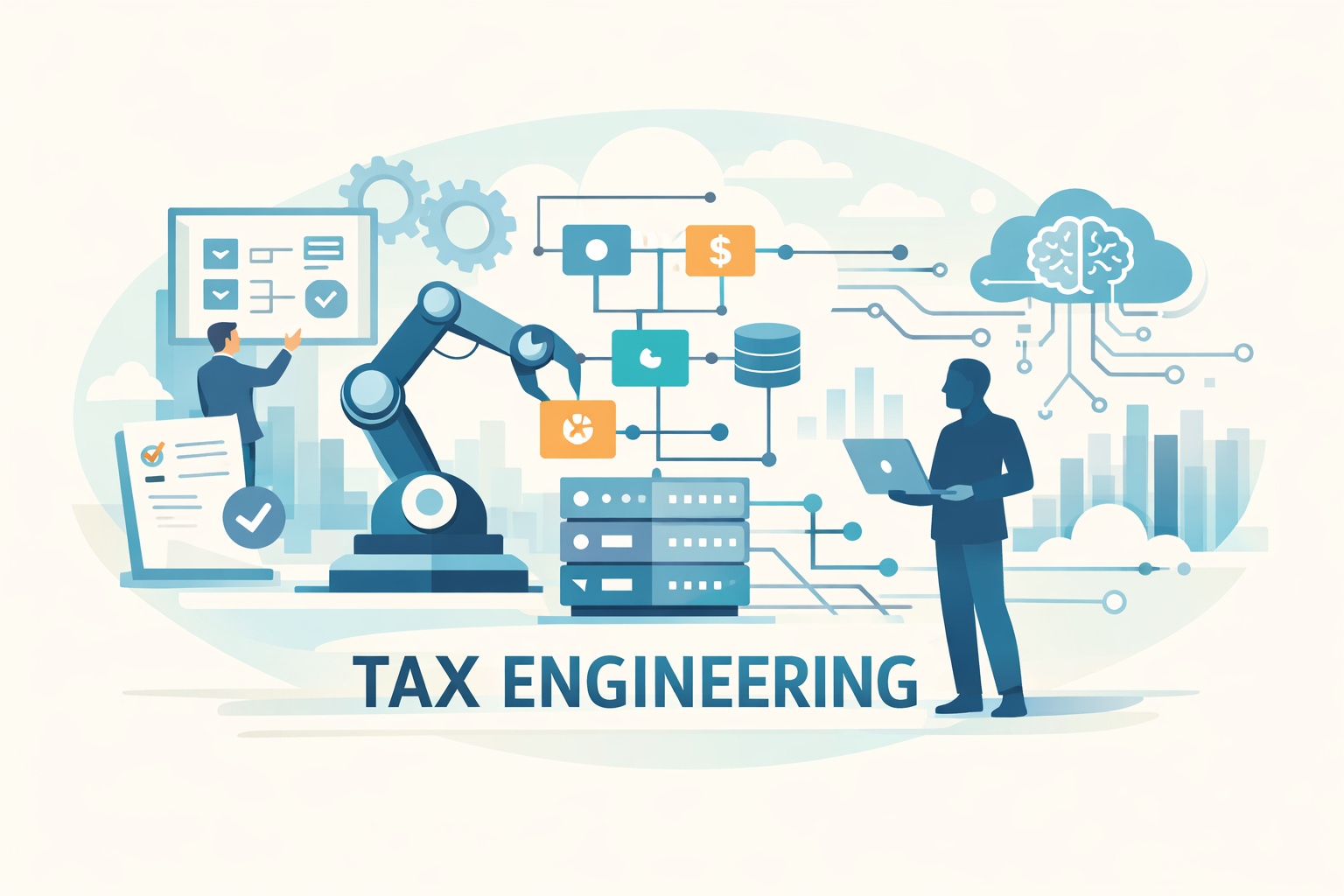
Systems thinking is the deeper shift. Can you see how a tax rule translates into configuration logic? Can you identify where a system’s limitations will force trade-offs? Can you work at the intersection of law, data, and technology? That is what I would call the tax engineer skill set. Not replacing legal knowledge, but extending it into the domain where outcomes are actually determined.
Where This Goes
I started my career interpreting rules. I thought that was the job. It took real, sometimes frustrating experience — watching good analysis fail at the point of execution — to understand that the job is bigger than that.
Tax is not becoming less technical or less legal. It is becoming more integrated. The professionals who will define the next era of this field will not be the ones with the deepest knowledge of a single jurisdiction’s rules. They will be the ones who can translate those rules into systems, work alongside AI without outsourcing their thinking, and make sound decisions when the system cannot do what the law demands.
The profession is not disappearing. But it is being reengineered. The question is whether you are the one doing the engineering — or the one waiting to find out what the new design looks like.